How AI Agents Work: The Agent Loop Explained
Blog / How AI Agents Work: The Agent Loop Explained
What is an AI agent? And how is it different from just asking a chatbot a question?
The Single-Call Problem
A single language model call can only answer from what is in its immediate prompt. It cannot look things up, run code, or take an action outside itself.This is a problem for tasks that need several steps where each step depends on the last.Imagine you need to fix a bug in a codebase. You cannot fix it in one step. You first need to discover the error, read the specific file, and then test a fix. You need the output of one step to perform the next.So how can we solve this problem? This is where the agent loop comes in.The Agent Loop
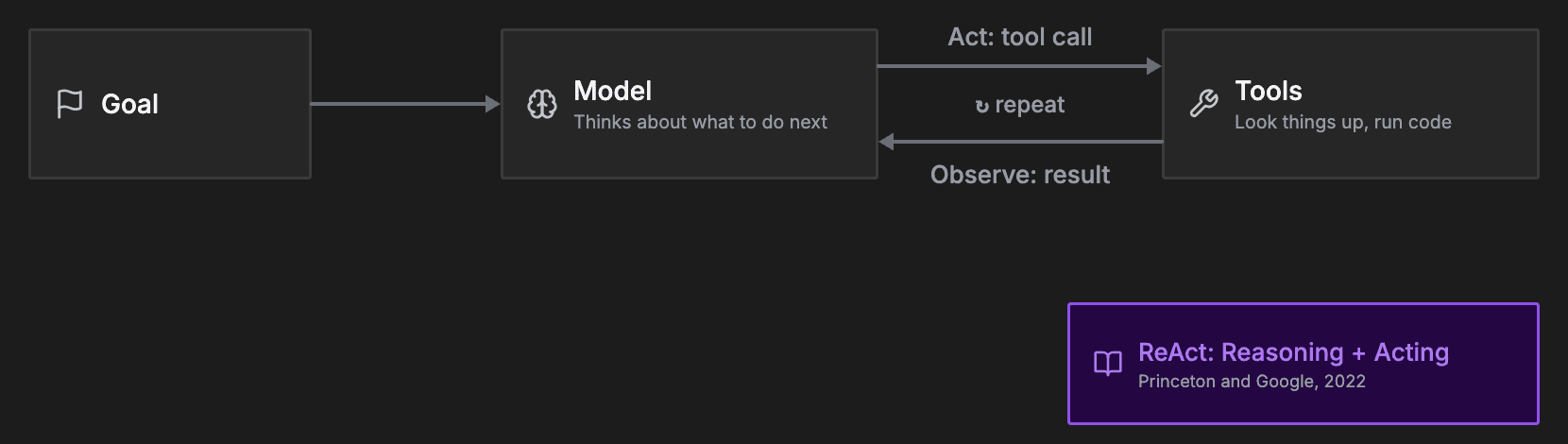
An AI agent is a language model using tools in a continuous loop to reach a goal.- Think: the model thinks about what to do next.
- Act: it picks an action, which is a tool call.
- Observe: the result is observed and added to the context.
Tool Calling: Your App Runs the Tools
A common misconception is that the model runs the code itself. The model never runs code natively.It returns a request to call a tool with specific arguments. Your application executes this request and sends the result back.The Model Context Protocol is a standard way to give an agent its tools.Stop Conditions
The loop ends when the model gives a final answer, or a stop condition is hit. Common stop conditions include:- A maximum number of steps.
- A cost or token budget limit.
- A strict timeout.
Memory: Context Window vs Long-Term
As the agent loops, it needs to remember its progress.Short-term memory is the model context window. It holds the conversation and every tool result so far. It is ephemeral and fills up quickly.Long-term memory is an external store the agent reads from and writes to. This is usually a vector database or graph database.An Agent End to End
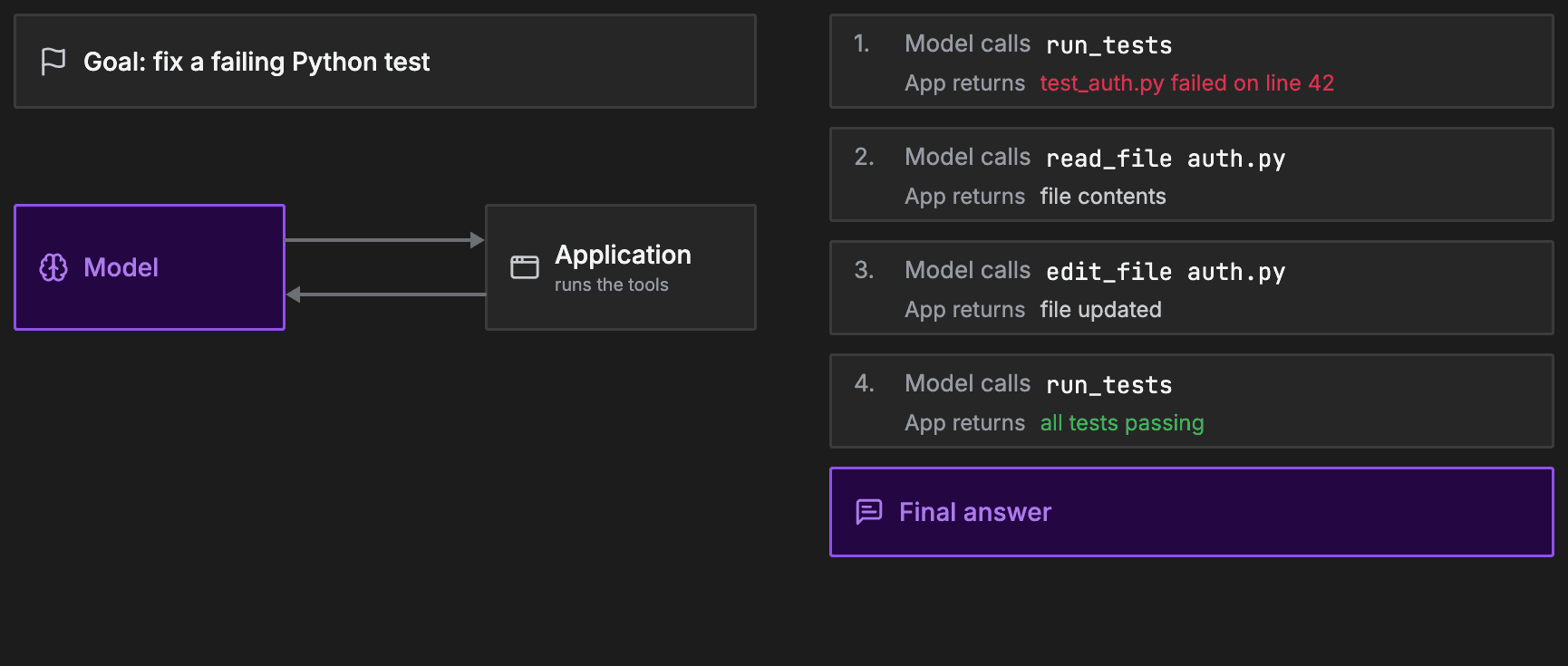
Let's look at one coding agent run step by step. The goal is to fix a failing Python test. Here is how the tool calls play out:- Step 1: the model calls run_tests. The application runs the tests and returns that test_auth.py failed on line 42.
- Step 2: the model calls read_file for auth.py. The application returns the file contents.
- Step 3: the model thinks about the logic error and calls edit_file with the new code. The application updates the file and returns a success message.
- Step 4: the model calls run_tests again. The application returns that all tests are passing.
Workflows vs Agents
A workflow follows steps a developer fixed in code. The language model simply processes data at specific steps. You use a workflow when the task is predictable.An agent lets the model decide the steps dynamically. You actually need an agent for open-ended tasks where the steps cannot be known in advance.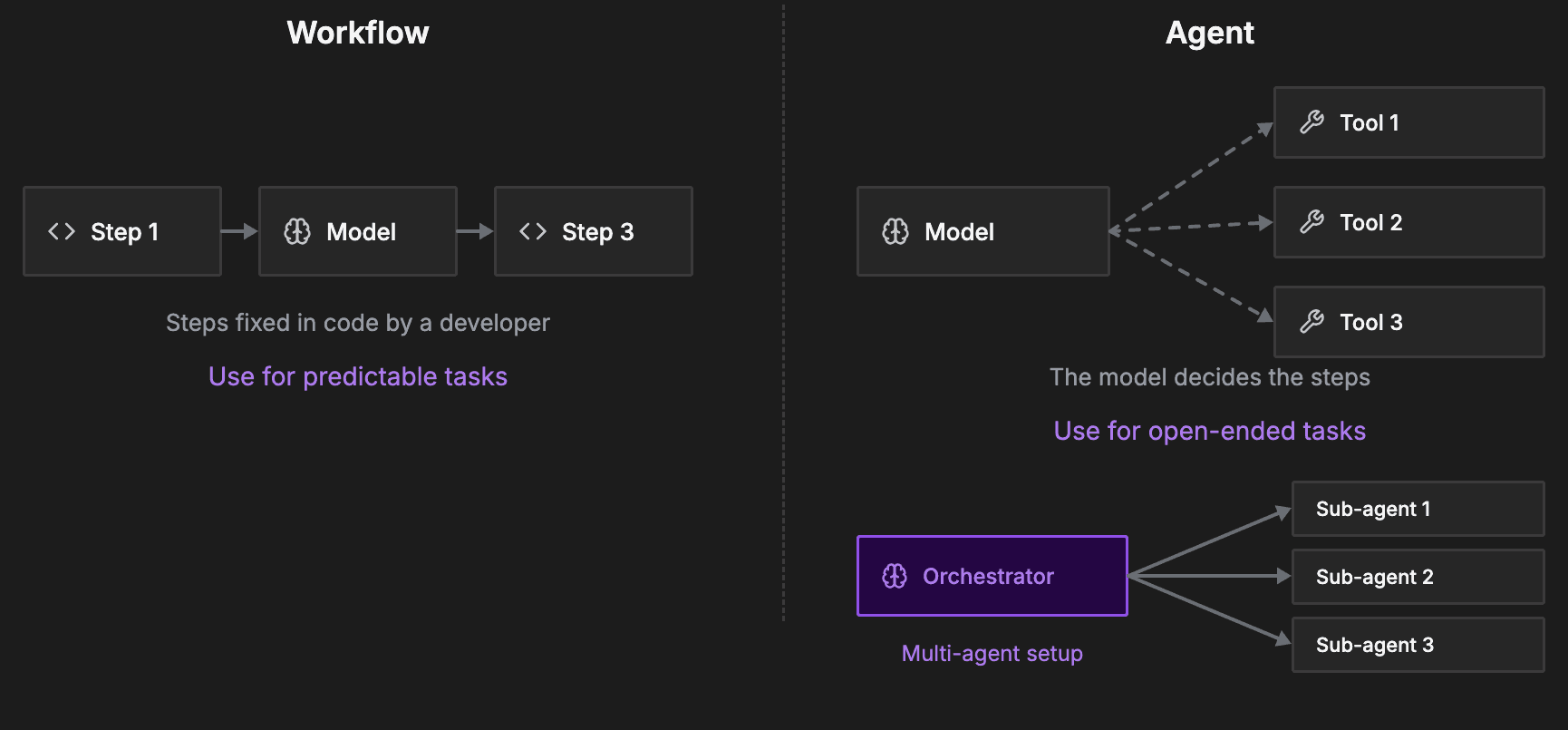
Failure Modes and Guardrails
Agents have unique failure modes. Common failures include:- Loops that never end.
- Errors that compound across steps.
- High cost and latency.
- Prompt injection through tool output.
- We enforce step limits to break infinite loops.
- We put a human in the loop to approve risky actions.
- We use least-privilege tools to restrict access.
- We use sandboxing to run the application safely.
Recap
| Term | Definition |
|---|---|
| AI agent | A language model using tools in a loop to autonomously reach a goal |
| Agent loop | The repeated cycle of thinking, acting, and observing |
| ReAct | The prompting pattern that combines reasoning and acting |
| Tool calling | The model outputting a request for the application to run a specific function |
| Stop condition | A hard limit or final answer that forces the loop to end |
| Short-term memory | The model context window, which holds the current session and fills up over time |
| Long-term memory | An external database the agent reads from and writes to |
| Workflow | A system where developer-written code dictates the order of steps |
| Guardrail | A safety measure to limit what the agent can break |
About TechPrep
Never walk into a technical interview unprepared again. TechPrep empowers software engineers to stop guessing and start getting offers. We provide the exact questions asked by tech companies across Data Structures & Algorithms, System Design, Low-Level Design & AI coding rounds. Don't leave your career up to chance. Join thousands of engineers who have successfully navigated the tech hiring maze and landed roles at top tech companies.