Monoliths vs Microservices
Blog / Monoliths vs Microservices
So what are the core differences between monoliths and microsevices?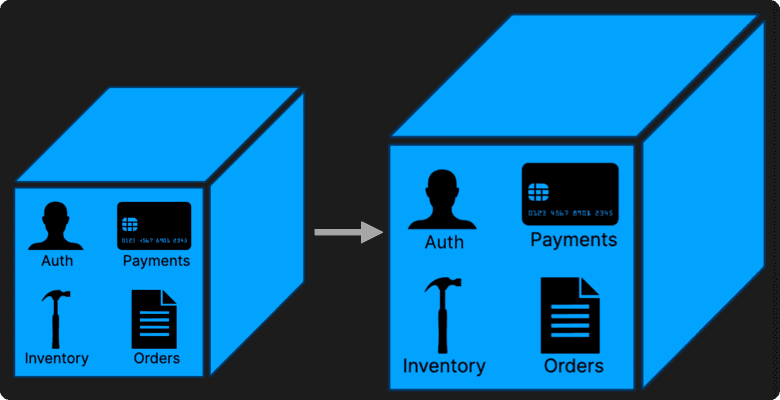
TL;DR Summary
- Monolithic architectures combine all functionalities into a single, tightly coupled codebase, whereas microservices break an application into small, independently deployable services that communicate via well-defined interfaces.
Monoliths
- A Monolithic Architecture is a traditional software design approach where all components and functionalities of an application are packaged and deployed as a single unit. This typically means that the user interface (UI), business logic, and data access layers are all part of one large codebase.
Scaling Example
- Imagine an online bookstore application where the user authentication, payment processing, inventory management, and order history all live in a single codebase. If you decide to scale, you have to scale the entire application - even the parts you don’t really need to scale as much - like the user authentication.
Advantages
- Simplicity: Easier to understand and develop initially, since everything is in one place.
- Easy Deployment: There’s only one executable or codebase to deploy, making it simpler to roll out updates.
- Straightforward Testing: Testing can be simpler because you’re dealing with one codebase and a single deployment unit.
Disadvantages
- Scalability: Scaling means duplicating the entire application, which can be inefficient.
- Tight Coupling: A small change in one module can potentially affect the entire system.
- Slower Development Over Time: As the codebase grows, it becomes increasingly complex to maintain and update.
When To Use?
- Smaller Applications: When the application is not too large or complex, and you can manage it with a small team.
- Tight Deadlines: If you need to deliver a minimum viable product (MVP) quickly.
- Stable Requirements: When the application’s functionalities aren’t expected to change drastically in the near future.
Real World Example
- Early Versions of eBay when it didn’t have to handle the massive scale it deals with today.
Microservices
- A Microservices Architecture breaks down the application into smaller, independent services. Each service is responsible for a specific piece of functionality and can be developed, deployed, and scaled independently of the others.
Scaling Example
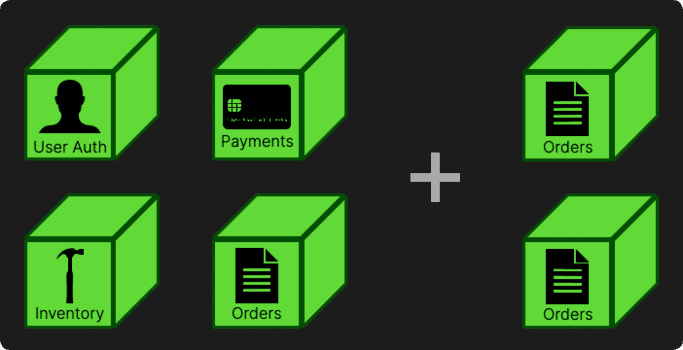
- Consider that same online bookstore, but now split into separate services:
- User Auth Service: Manages user profiles and authentication.
- Payment Service: Deals with payment processing.
- Inventory Service: Handles inventory and product details.
- Order Service: Manages order creation and tracking.
- Each service runs independently. If you need more capacity to handle orders, you scale only the Order Service.
Advantages
- Independent Deployment: You can update or scale individual services without redeploying the entire system.
- Fault Isolation: A failure in one service doesn’t necessarily bring down the entire application.
- Flexibility in Technology: Each service can use a different stack or framework that is best suited for its function.
Disadvantages
- Increased Complexity: Managing many services, each with its own database and deployment pipeline, can be challenging.
- Communication Overhead: Services must communicate over the network, which can introduce latency and potential points of failure.
- Monitoring and Debugging: It can be harder to track issues across multiple services.
When To Use?
- Large and Complex Applications: Where different features may need different scaling and specialized teams.
- Rapid Development: When you have multiple teams working on different services simultaneously.
- Frequent Updates: If new features or changes are being added continuously, and you want minimal downtime.
Real World Example
- Netflix: Known for pioneering microservices at a massive scale.
- Amazon: Early adopter to handle huge volumes of e-commerce transactions.
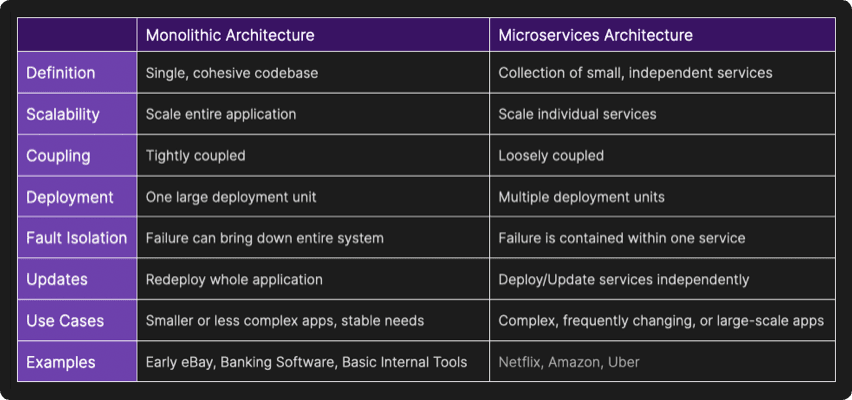
Core Differences
About TechPrep
Never walk into a technical interview unprepared again. TechPrep empowers software engineers to stop guessing and start getting offers. We provide the exact questions asked by tech companies across Data Structures & Algorithms, System Design, Low-Level Design & Practical coding rounds. Don't leave your career up to chance. Join thousands of engineers who have successfully navigated the tech hiring maze and landed roles at top tech companies.